How to measure what really changes in women’s fashion when each season brings its share of proclamations about trends? Between the rise of second-hand, new European regulations, and the key pieces from the spring-summer 2026 shows, the signals do not all point in the same direction. This article compares the available data to distinguish underlying movements from mere announcements.
Second-hand and new purchases: what the numbers reveal about women’s fashion
The second-hand market is growing in France, but the dynamics vary according to distribution channels.
| Sales Channel | Recent Evolution | Share of Purchases |
|---|---|---|
| Professionals (thrift stores, in-store corners) | Sustained growth | Significantly increasing |
| Sales between individuals (online platforms) | More moderate growth | Still significant |
| Physical circuits (shops, consignment stores) | Stable to slightly positive | Still a significant share of the total |
Professionals, particularly thrift stores and integrated corners within brands, have experienced a stronger growth than sales between individuals. Physical shops still represent a non-negligible share of second-hand purchases.
Refashion brings a nuance rarely mentioned in style guides: the environmental benefit of second-hand depends on actual substitution. Buying a second-hand item in addition to, rather than instead of, a new garment does not reduce the overall footprint. This distinction separates a style that can be deemed responsible from simply increased consumption, and current trends that promote fashion on Mademoiselle Camille would benefit from incorporating this criterion.

Fashion Regulation 2026: Anti-Fast Fashion Law and European Rule on Unsold Goods
Two regulatory frameworks are changing the game for brands and, by extension, for consumers. Their scope goes far beyond style considerations.
The French Law of July 8, 2026
This law directly targets ultra-fast fashion. It includes a penalty related to the sustainability of certain textile products, which means that the least durable items will cost more to produce or market in France. For a women’s wardrobe, the effect will first be seen in the prices of entry-level items that are renewed at a very high frequency.
The European ESPR Rule on Unsold Goods
At the European level, the ESPR (Ecodesign for Sustainable Products Regulation) regulates the management of unsold clothing and shoes. It encourages their reuse, resale, or donation rather than destruction. This rule affects how brands manage their collections beyond the visible trends in stores, with a direct impact on the availability of end-of-line items.
Both measures converge towards the same effect: collections with very rapid turnover become more costly for brands to manage. Consumers who follow seasonal trends will likely see a restructured offer, with more long-lasting pieces on the shelves.
Women’s Fashion Trends Spring-Summer 2026: The Pieces That Structure Looks
Rather than listing twelve micro-trends, three axes deserve in-depth examination because they reflect concrete wardrobe choices.
- Leather, ubiquitous on the runways, appears in various pieces (skirts, short jackets, trousers). Its massive presence this season raises questions: alternatives in plant-based or recycled leather are gaining ground, aligning with regulatory pressure on material sustainability.
- Red, ranging from vermilion to burgundy, dominates the color palettes. This strong chromatic choice simplifies the construction of a look since a single red piece is enough to structure an entire outfit.
- Short cuts are making a strong comeback, from shortened trench coats to colorful jackets cut above the waist. The barrel jean, with its flared silhouette and high waist, complements this trend towards more pronounced proportions.
Leopard print has persisted for several seasons, often paired with a touch of red, as reported by specialized blogs. The longevity of this print in women’s wardrobes makes it less of a fleeting trend and more of a recurring basic.
Colors and Style: What Distinguishes the Fall-Winter Season from Spring Collections
Seasonal palettes do not merely change in hue. They reflect different wardrobe logics.
Butter yellow, identified as the key color for spring-summer 2026, illustrates a shift towards soft and bright tones. In fall-winter, collections traditionally favor more muted shades (khaki, gray, black). The gap between the two palettes necessitates wardrobe choices: a butter yellow piece bought in April does not naturally fit into an October wardrobe.
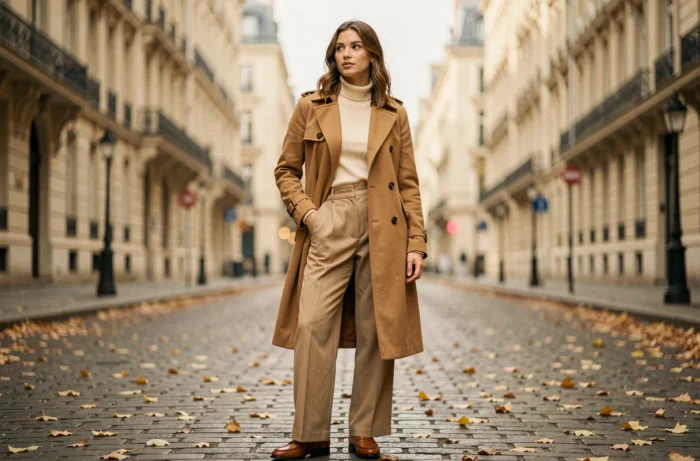
The oversized sweater, identified as a trend for spring-summer 2026, blurs the usual seasonal boundary. Worn over beige trousers or a barrel jean, it works across a wide thermal range, making it a more rational investment than a strictly summer piece.
Consumers who browse fashion inspirations on Instagram or Pinterest will primarily find very seasonal looks. Trans-seasonal pieces remain underrepresented in online inspiration, even though they often provide the best cost-per-use ratio in a women’s wardrobe.
Current women’s fashion thus reads on two levels: visual trends, driven by runway shows and social media, and structural constraints, driven by regulation and the evolution of the second-hand market. The former change each season. The latter sustainably reshape the available offer in stores.