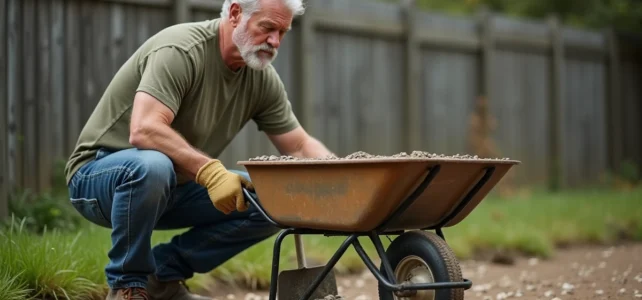
A gravel courtyard that has aged, stones embedded in the ground after years of foot traffic, a project for a slab or lawn that requires everything to be removed: the work always begins with the same difficulty. Gravel cannot be collected like fallen leaves, especially when it has mixed with the soil several centimeters deep.
Before choosing a tool or technique, one must assess the thickness of the layer, the presence or absence of a geotextile underneath, and the total area to be treated.
See also : Discover all the Breton news: info, culture, and events not to be missed
Mechanical screening of gravel: the method few individuals know
When it comes to removing gravel, most online content describes the shovel, rake, and wheelbarrow. For a small area of a few square meters, that is sufficient. For an entire courtyard, it becomes a physical ordeal that takes days.
The most effective solution for medium to large surfaces involves the rental of a screener or stone harvester. These machines mechanically separate the soil and stones to a depth of about fifteen to twenty centimeters. Gravel is collected on one side, and cleaned soil on the other. Some equipment rental companies for construction and agriculture offer these tools to individuals.
Recommended read : Recovery of the security deposit: practical tips to easily get your deposit back
The benefits are twofold: considerable time is saved, and the topsoil is kept in place, which avoids the need to buy more if planting is desired later. For those looking for methods to remove gravel without straining their backs, this is the option to prioritize as soon as the area exceeds a few square meters.
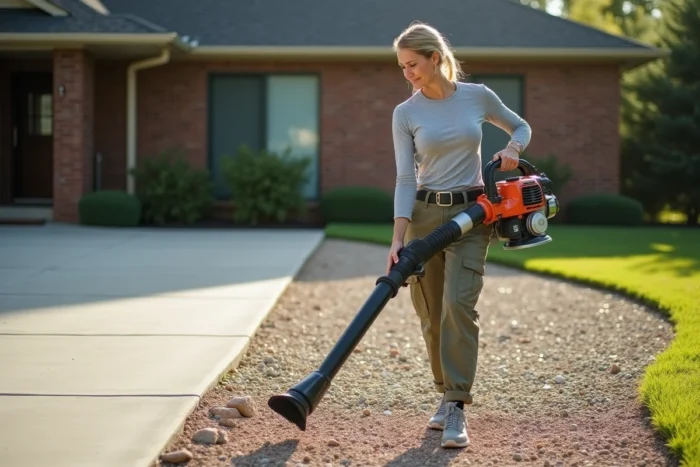
Manual removal of gravel: tools and order of operations
For modestly sized courtyards or hard-to-access areas (corners, edges, proximity to plants), the work is done by hand. The basic equipment remains simple, but the order in which one proceeds changes everything.
Clearing the surface layer
Start by scraping the gravel on the surface with a flat shovel or a wide-toothed rake. The goal is to gather as many stones as possible into a pile before loading them into a wheelbarrow or container. On gravel laid on geotextile, this step is quick: the fabric prevents the stones from sinking, and one can often roll the geotextile with the gravel on top.
Extracting gravel embedded in the soil
Without geotextile, gravel migrates into the soil over the years. A rake with teeth at least ten centimeters long allows for digging into the soil and bringing up the embedded stones. Rake in crossed passes (north-south, then east-west) to leave nothing behind.
A point not to be overlooked: weeding before starting the removal, not after. Roots hold the stones and complicate the raking. Since the Labbé law, chemical herbicides are banned for individuals on outdoor surfaces. Therefore, one is limited to thermal weeding (gas burner) or manual pulling.
- Flat shovel to scrape the surface layer and load wheelbarrows
- Long-toothed rake to extract gravel embedded in the soil
- Reinforced wheelbarrow or mini-dumper to remove large volumes without multiple trips
- Thermal burner to eliminate weeds before the project
Disposing of gravel: weight, volumes, and waste disposal constraints
The volume and weight of gravel to be disposed of are almost always underestimated. Even a modest layer in a courtyard generates significant quantities, much heavier than green waste or potting soil.
Planning for a suitable container or skip avoids unpleasant surprises. Several options exist depending on the volume:
- For small quantities, sturdy rubble bags (like “big bags”) that are then picked up by a service provider
- For intermediate volumes, renting a skip placed in the driveway, with scheduled pickup
- For large projects, a tracked mini-dumper that transports the gravel directly from the removal point to the loading point, without damaging the remaining soil
Before throwing everything away, check if the gravel is reusable. Clean gravel of good grain size can easily be sold or given away through local platforms. Feedback varies on this point, but many individuals find takers within a few days for gravel in good condition.
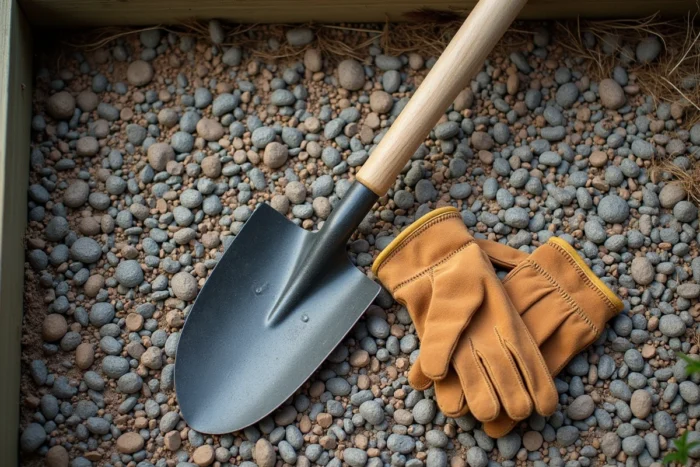
Preparing the soil after gravel removal
Removing gravel is not enough: the soil underneath is almost always compacted, impoverished, and sometimes impermeable. If a new covering is laid directly, the results will be poor.
Aerating the soil deeply is the first action to take. Digging to a minimum depth of twenty centimeters breaks the surface crust. If planning to plant grass, the soil should be analyzed to choose an appropriate amendment: if too clayey, it retains water and suffocates the roots; if too sandy, it retains nothing.
For a slab, terrace, or new mineral covering, check the level with a bubble level and compact with a vibrating plate. If the soil has significant dips where the gravel had sunk, fill them with gravel before compacting.
The geotextile deserves a mention: if the old one is still in place and in good condition, it can be reused under a new covering. A torn or punctured geotextile must be replaced; otherwise, weeds will return in a few months.
The complete removal of gravel from a courtyard remains a physical task, even with suitable equipment. The difference between a project that drags on and one completed in a weekend often lies in the choice of tools and the logistics of disposal, more than in the removal technique itself.