When renovating a living room or a living space, indoor air quality and the origin of the materials used in your home are just as important as choosing a wall color or a sofa. Interior design trends are now structured around this requirement: what is installed in a space must be traceable, healthy, and sustainable before it is beautiful.
Formaldehyde regulation and furniture choices: what is changing concretely
A particle board, a laminate adhesive, a flat-pack furniture: these common elements emit formaldehyde, an irritating compound. The REACH regulation (Annex XVII, entry 77), whose new limits were summarized by HTP Global in August 2026, lowers the permitted emission thresholds for panels and adhesives used indoors.
For a renovation or layout project, this means that one can no longer simply choose a piece of furniture from a catalog without checking its technical specifications.
On the ground, interior architects and planners are directing their purchases towards certified low-emission panels. The FSC certification, which guarantees the traceability of wood from the forest, is gaining momentum according to the Mordor Intelligence report on the European sustainable furniture market. We are moving from a marketing argument (“eco-friendly furniture”) to a verifiable technical selection criterion.
Specifically, when choosing a kitchen or custom storage, asking for the emission certificate of the panel and the origin of the wood becomes a reflex comparable to checking an energy performance diagnosis (DPE) before a real estate purchase. Studios like Dofacto Design & Déco integrate this traceability logic from the design phase for their layout projects.
Acoustic comfort in the living room and living spaces: an underestimated angle
There is a lot of talk about colors and natural materials, but rarely about noise. Acoustic comfort is rising sharply in the priorities of recent projects. In a living room open to the kitchen, with large format tiles and little textile, the noise level rises quickly. Conversations overlap, and the sounds of dishes resonate.
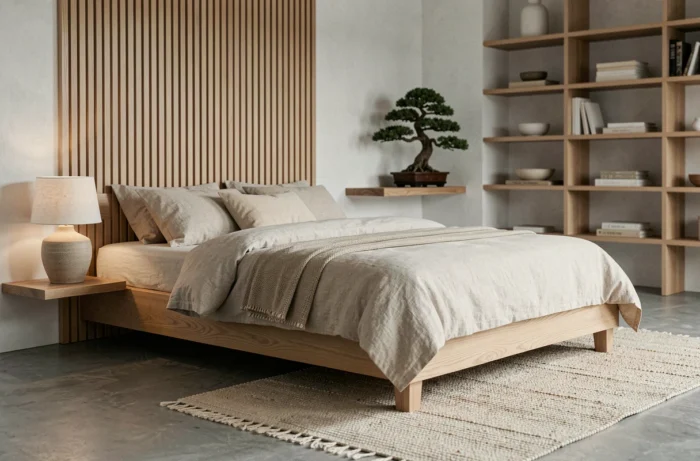
The solution does not rely solely on a thick rug. Wall panels made of felt, perforated wood, or natural fibers today combine decoration and sound absorption. They are installed like a classic wall covering, but they measurably reduce reverberations.
- Recycled felt panels come in neutral or earthy tones, compatible with a calming palette.
- Wood slats spaced on an absorbent backing serve a dual purpose: visual texture and acoustic correction.
- Thick linen curtains, often overlooked, contribute to sound absorption in glass-walled rooms.
Feedback varies on this point: effectiveness depends on the volume of the room and the treated surface. A complete wall of absorbing panels radically changes the sound atmosphere of a living room, while a single decorative element will have a limited effect.
Biophilic design in 2024: beyond potted green plants
Biophilic design appears in all competing articles, often reduced to “add plants and wood.” In practice, this approach has evolved towards an integrated structural logic from the design of the space. Recent content analyzed by La Basad describes more ambitious devices: automatically irrigated green walls, physical continuities between indoors and outdoors, natural light planned in advance with openings.
The choice of raw materials (stone, solid wood, terracotta) is no longer just about aesthetics. They are selected for their sensory effects: the coolness of a limestone floor in summer, the tactile warmth of an oiled wood countertop, the irregular texture of a lime plaster.
Natural light and room orientation
A serious biophilic project begins with an analysis of orientation. A living space facing north is not treated like a south-facing living room. Increasing natural light reduces dependence on artificial lighting and alters the perception of wall colors. A sage green appears dull under neon lights but takes on its full depth in lateral natural light.
Adjustable slat blinds are gradually replacing blackout curtains in recent renovations. They allow for light control without completely blocking the visual connection with the outside.
Sustainable materials and color palette: combinations that work in renovation
Calming colors dominate the 2024 palette: deep greens, earthy tones, warm off-whites. What distinguishes a successful project from a bland interior is the combination of these shades with the material that carries them.
- A lime plaster in an ochre tone creates a depth that acrylic paint cannot replicate, thanks to its surface variations.
- Terrazzo, whether on the floor or as a countertop, brings chromatic movement without resorting to printed patterns.
- Natural wood joinery (light oak, ash) frames openings with a warmth that white PVC does not provide.
The challenge is not to follow a trend, but to choose materials that age well. A solid oak floor develops a patina over time. A wood-patterned laminate deteriorates. In a renovation project for a living room or kitchen, this trade-off between initial cost and actual durability determines long-term satisfaction.
Material traceability, acoustic comfort, natural light: these three technical parameters, negotiated from the beginning of a project, condition the durability and comfort of a space far beyond the choice of finishes.