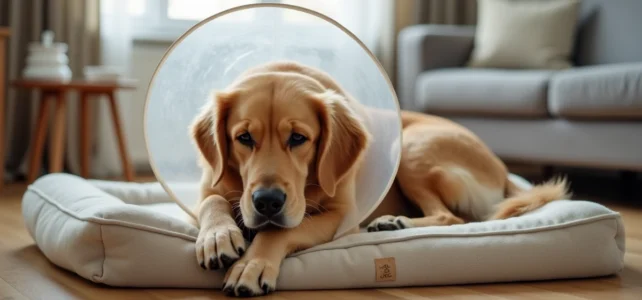
A dog that has undergone surgery and is wearing an Elizabethan collar cannot be monitored constantly. The question of when to leave them alone and how to secure this isolation arises as soon as you return from the clinic. The answer relies less on the duration of absence than on the physical confinement of the animal and the proper maintenance of the collar throughout the healing period.
Post-operative confinement of the dog: the real lever before the collar
Recent veterinary guides clearly distinguish between two risks: licking the wound (which the collar prevents) and uncontrolled physical activity (which only confinement limits). A dog free to roam the entire home can jump on a couch, climb stairs, or interact abruptly with another animal, even with a perfectly fitted collar.
Read also : How to Choose the Right Rectangular Glasses: Essential Tips and Criteria
Confinement involves restricting the available space to a transport crate, a puppy pen, or a small closed room. This setup protects the surgical wound much more effectively than simple intermittent monitoring.
Before leaving a dog alone after surgery, it is essential to prepare this restricted space: remove any objects on which they could get caught with the collar, place the water bowl at an accessible height, and ensure the floor is not slippery.
See also : All the methods to easily and effectively remove gravel from your yard
When to leave them alone
It is generally possible to be absent for short periods starting from the third day after a spay, provided that the dog is confined and wearing their collar continuously. The first 48 hours remain the most sensitive period, where regular human presence allows for quick detection of bleeding, abnormal swelling, or removal of the protection.
It is not the absence that endangers healing, but free access to the home. A dog confined in an appropriate pen, with the collar in place, is at less risk alone than a “monitored” dog that is free to move around.
Adjustment of the collar: common mistakes that complicate solitude
A poorly adjusted collar poses a minor problem when the owner is present (they can correct it in real time) but becomes a real danger when the dog is alone. Two mistakes consistently recur.
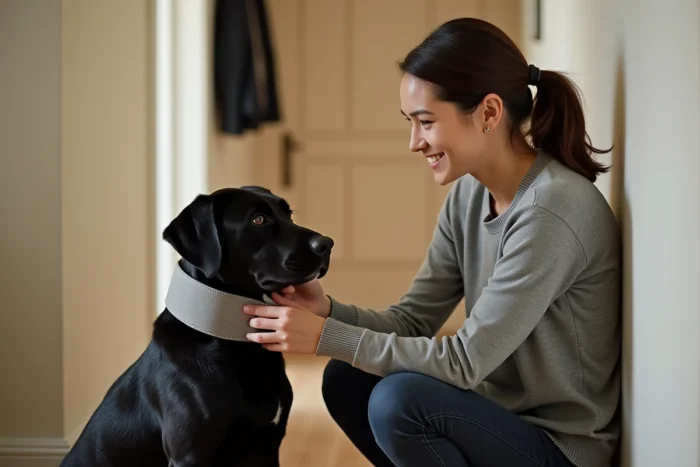
The first: a collar that is too loose. The dog can maneuver it backward, giving them access to the wound. The verification test is simple: two fingers should fit between the edge of the collar and the neck, no more. If three fingers fit, the adjustment is insufficient.
The second: a collar that is too short. The front edge must extend beyond the dog’s muzzle by at least a few centimeters to prevent the tongue from reaching the operated area. For dogs with long muzzles (herding dogs, greyhounds), the standard size provided by the clinic is sometimes insufficient.
- Check the adjustment morning and evening, as post-operative swelling of the neck decreases over the days and the collar gradually loosens
- Inspect the skin under the collar for any redness or friction irritation, especially in breeds with thin skin
- Ensure the collar is secured to the dog’s collar (and not just placed around the neck) to prevent them from removing it by rubbing against furniture
Rigid, soft, or inflatable collar: which one for a dog left alone
The choice of collar type radically changes the experience of a confined dog without supervision. The rigid plastic collar remains the most mechanically reliable: it prevents access to almost the entire body. Its main drawback is that it bumps against walls, cage bars, and bowls, causing stress and noise.
The inflatable collar (like a buoy) offers more comfort and fewer snags in a confined space. It is well-suited for wounds located on the trunk. However, it does not block access to the tips of the paws or the muzzle, making it unsuitable for surgeries on limbs or the face.
The soft fabric collar represents a compromise: less noise, fewer snags, but some determined dogs manage to bend it to reach the wound. For a dog left alone, sturdiness takes precedence over comfort.
The post-operative body as a complement
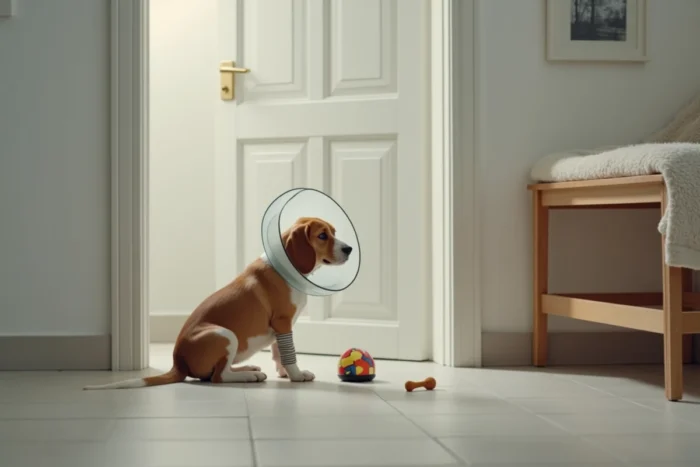
For abdominal surgeries (spaying, digestive surgery), a veterinary body worn under the collar adds an additional physical barrier. It is not a replacement for the collar but a useful safety net when no one is there to intervene if the dog manages to circumvent the collar.
Warning signs to check upon return after an absence
Each return home after leaving the dog alone should include a quick and methodical inspection. Post-operative healing follows a predictable timeline, and any visible deviation warrants a call to the veterinarian.
- Is the collar still in place and correctly oriented (not turned, not slipped to the side)
- Does the wound show any oozing, fresh bleeding, swelling, or unusual odor
- Does the dog show signs of abnormal distress: continuous panting, trembling, refusal to get up, unusual vocalizations
- Does the area under the collar (neck, jaw) show any signs of friction marks or skin lesions
Licking of the wound that occurred during the absence is often indicated by the presence of wet or matted fur around the operated area, even if the collar appears to be in place upon return.
The duration of collar wear varies depending on the procedure, but the typical range after a spay is around ten to fourteen days. Removing the collar before veterinary confirmation remains the primary cause of preventable complications. Even if the wound appears closed on the surface, the deeper tissues may still be fragile. The final veterinary check, the one that authorizes removal, remains the only reliable criterion for ending this confinement period.