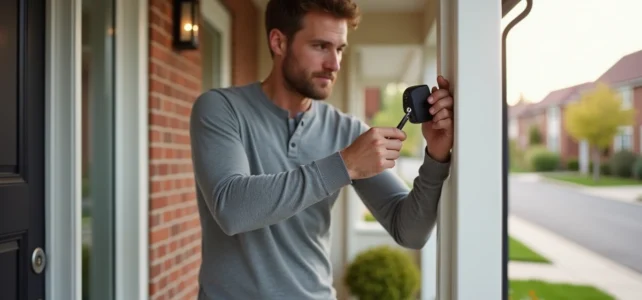
Cameras, smart locks, app-controlled motion detectors: home security equipment has multiplied in recent years. Their actual effectiveness depends less on the number of devices installed than on how they communicate with each other and resist software vulnerabilities. Comparing protocols, regulatory requirements, and analytical capabilities allows us to measure what separates a reliable connected system from a mere gadget.
Communication Protocols: What Differentiates a Reliable System from a Fragile Assembly
Most connected security guides list product categories (cameras, alarms, doorbells) without addressing the technical foundation that determines their reliability. The communication protocol between devices is the primary selection criterion.
Further reading : Discover how to navigate easily with the Chroniques Blondes sitemap
The Matter standard, whose version 1.6 was recently published, simplifies multi-ecosystem installation and enhances interoperability among manufacturers. A home automation system based on Matter allows a smart lock, a motion detector, and an alarm from different brands to communicate without going through a proprietary bridge.
The solutions offered on homedome.fr illustrate this integration logic, where the choice of protocol precedes that of the devices themselves.
Related reading : How to Boost Your Business Visibility with an Effective Online Presence
| Criterion | Classic Wi-Fi | Zigbee / Z-Wave | Matter 1.6 |
|---|---|---|---|
| Signal Range | Average (depends on the router) | Good (mesh network) | Good (mesh network, multi-transport) |
| Interoperability | Limited (closed ecosystem) | Partial (pairing required) | Native among compatible manufacturers |
| Energy Consumption | High | Low | Low to moderate |
| Security Updates | Variable by manufacturer | Variable | Regulated by the standard |
A home Wi-Fi network remains the weak link in most installations. Segmenting the network by creating a VLAN dedicated to connected objects limits the attack surface if one of the devices is compromised.

Cyber Resilience Act: New Obligations Changing the Home Security Market
The European regulation on cyber resilience (Cyber Resilience Act), which comes into effect at the end of 2024, imposes unprecedented requirements on all products containing digital elements sold in the European Union. Connected security equipment (cameras, alarms, locks) is directly affected.
Manufacturers must ensure a baseline of security by design and by default. This means mandatory updates throughout the expected lifespan of the product, documented vulnerability management, and compliance assessment before market release.
For buyers, this regulatory framework changes the reading grid. A cheap connected alarm system whose manufacturer does not publish any software patches after sale will no longer be compliant. In contrast, brands that already integrated these practices will not need to modify their range.
- Check that the manufacturer commits to a software support duration (firmware updates) of at least several years after purchase
- Prefer products with a declaration of compliance with the Cyber Resilience Act, mentioned in the technical documentation
- Exclude IoT devices without a published vulnerability management policy on the manufacturer’s website
A device compliant with the Cyber Resilience Act offers a higher level of network protection than equipment sold before the regulation came into effect, even at an equivalent price.
Generative AI and Behavioral Analysis: Beyond Simple Motion Detection
Classic connected cameras trigger alerts as soon as motion is detected. The result: dozens of false notifications per day (a cat, a branch, a reflection). Recent systems integrate generative AI models capable of distinguishing a familiar face from an intruder and characterizing suspicious behavior.
Generative AI generates contextualized alerts in real-time, describing the detected situation rather than sending a simple image capture. A system can, for example, report “unknown person lingering in front of the front door for several minutes” instead of a generic “motion detected.”
This analytical capability significantly reduces the false alert rate. It requires local data processing (edge computing) or encrypted sending to a remote server, which raises questions about the protocol and GDPR compliance.
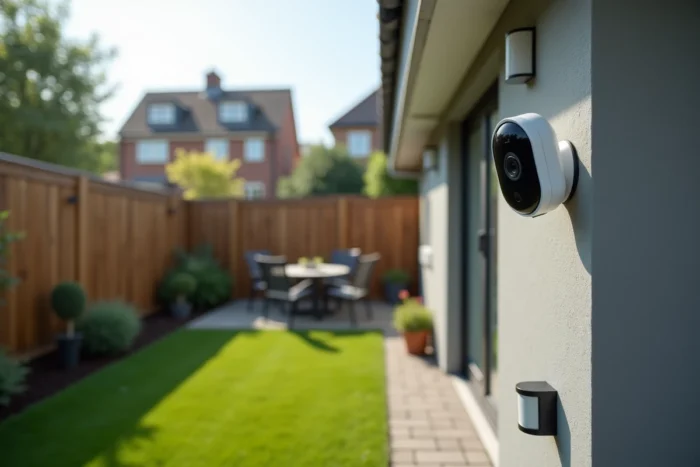
Current Limitations of Residential Facial Recognition
Facial recognition applied at home is still regulated by the CNIL. Biometric recording of visitors without their consent is prohibited. The most compliant systems offer recognition limited to household members, voluntarily declared in the app.
Effectiveness also varies depending on lighting conditions. A camera positioned against the light or in a dark corridor loses reliability, even with a high-performing AI model. The physical placement of the device remains a technical parameter not to be overlooked.
Connected Access Control: Lock, Alarm, and Automated Scenarios
The interest of a connected security system lies not in each device taken in isolation, but in the automated scenarios that link them. A smart lock combined with an opening detector and an alarm can trigger a complete lockdown of the home at a set time, or when the last occupant leaves the geolocated perimeter.
- “Departure” scenario: locking the door, activating the alarm and cameras, cutting off certain electrical circuits via connected outlets
- “Intrusion” scenario: simultaneous triggering of the siren, sending an alert with video feed to the smartphone, and notification to a remote monitoring service
- “Return” scenario: deactivating the alarm via geolocation or code, turning on the entry lighting, unlocking the door
The reliability of these scenarios depends on the protocol used and the network latency. A system operating on Zigbee or Matter reacts in a few milliseconds. A 100% cloud-based system via Wi-Fi may have a delay of several seconds, sufficient for an alarm to trigger after the door has actually been opened.
The choice of a home automation security system hinges on three verifiable axes: the communication protocol between devices, the manufacturer’s compliance with the obligations of the Cyber Resilience Act, and the contextual analysis capability of alerts. A well-architected system with four coordinated devices offers better protection than a dozen isolated gadgets.