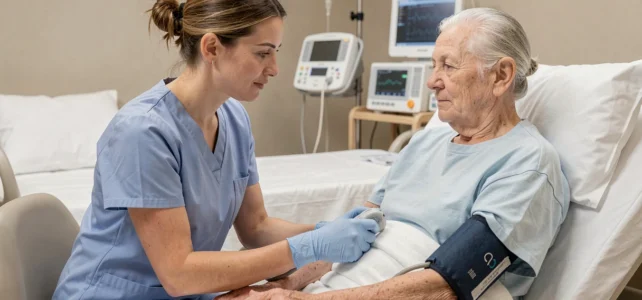
The decree of February 26, 2025, expands the scope of intervention for nursing assistants and redefines the authorized actions, clinical monitoring, and collaboration modalities with the nurse. On paper, the text structures a clear clinical shift. In practice, its implementation depends on variables that the framework does not address: internal protocols, available nursing supervision, and actual training time.
Nursing Assistant Actions in Acute Situations: What the Field Does Not Prepare For
The 2025-2026 framework allows nursing assistants to intervene in acute situations that until now were exclusively within the nursing scope. Clinical monitoring is no longer limited to observing general signs: it now includes the analysis of targeted parameters and the adaptation of actions based on the patient’s condition.
Related reading : Everything You Need to Know About the Conditions for Retired SNCF Beneficiaries and Their Benefits
The problem is structural. In the majority of medical-social establishments, care protocols have not been revised since the 2021 reengineering. The nursing assistant finds themselves with an expanded regulatory framework but outdated technical sheets that do not describe the new authorized actions. Without a written procedure validated by the health supervisor, the exercise of these actions remains legally fragile.
We observe a marked discrepancy between nursing homes and hospital services. In a hospital setting, the permanent presence of nurses allows for real-time supervision. In nursing homes, where the coordinating nurse sometimes covers several units, the nursing assistant performs new actions without immediate direct supervision. The framework provides for collaboration, not continuous physical presence.
See also : Argel 7: discover the contraindications to know before using it
Professionals who wish to learn everything about the nursing assistant framework 2026 will benefit from cross-referencing the regulatory text with the protocols actually in force in their structure, rather than limiting themselves to the list of theoretically authorized actions.
Written Transmissions and Care File: The Most Underestimated Skill
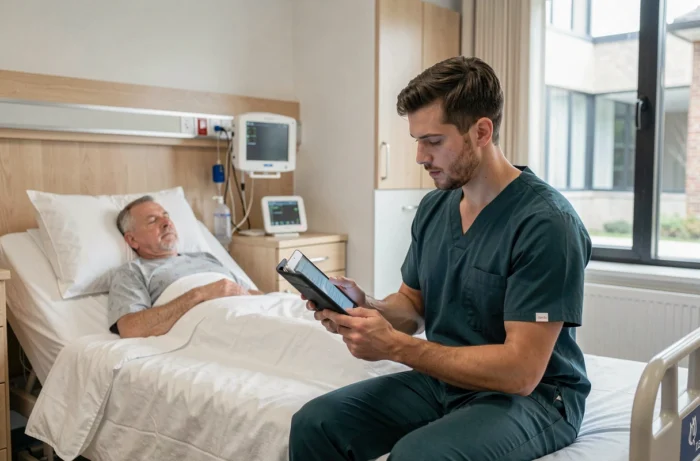
The framework repositions the nursing assistant as an active contributor to the care file. It is no longer just an oral report at the time of handovers. The written traceability of observations, recorded parameters, and actions performed becomes a formal requirement of the diploma and practice.
This evolution assumes two prerequisites that are rarely met:
- Effective access to the care software with data entry rights adapted to the nursing assistant profile, which implies specific IT configuration that many establishments have not yet deployed.
- Sufficient writing skills to produce targeted transmissions usable by the multi-professional team, distinct from simple factual reporting.
- Dedicated time in daily planning, while staff ratios have not been reviewed to include this additional documentation burden.
Digital health competency is now part of the expected foundation. At least one training organization explicitly includes it in the update program. This shift is significant for nursing assistants who graduated before 2021, as they were not trained in the use of digital traceability tools in their initial curriculum.
Updating Nursing Assistant Skills: Who Is Really Concerned
The update training targets nursing assistants holding a diploma issued before the 2021 reengineering. Graduates since that date are considered trained in the renovated framework. The distinction seems simple, but it generates ambiguous situations in the field.
A nursing assistant who graduated in 2020 and has been practicing continuously for five years often masters certain clinical actions better than a recent graduate. The framework does not provide for validation of experience specific to these new actions: the three-day update training is mandatory, regardless of the actual level of practice.
The content of this training, as described by several accredited organizations, covers three areas:
- The execution of new authorized care in acute situations, with practical situational training and evaluation.
- Monitoring and analysis of the clinical state within the nursing assistant’s scope, including the identification of warning signs.
- Multi-professional coordination and contribution to the care file, with a focus on written transmissions.
We recommend that health supervisors plan these trainings in pairs of nursing assistant/nurse referent. Training the nursing assistant without training the nurse who supervises their new actions creates an organizational blind spot that the framework does not address.

Nursing Supervision and Protocols: The Missing Link in the 2026 Framework
The regulatory text defines the actions, competencies, and training modalities. It says nothing about the organizational conditions for implementation. This is where the gap widens between the legal framework and the reality of establishments.
An authorized action without an updated internal protocol remains a risky action. A nursing assistant performing an action provided for in the framework but not covered by a validated procedure in their establishment exposes themselves to liability in the event of an adverse event. Responsibility does not rest solely on the professional: it also involves the management that has not formalized the exercise framework.
The referent nurse plays a pivotal role that the framework mentions without detailing. In structures where the nurse/nursing assistant ratio is low, the delegation of clinical monitoring operates by default rather than by protocol. Training nurses in their role of supervising new nursing assistant actions is not mentioned in any regulatory obligation, but it conditions the safety of the system.
Establishments that anticipate this transition invest in three simultaneous levers: rewriting care protocols to include expanded actions, cross-training nurses/nursing assistants, and configuring digital traceability tools. Those who limit themselves to sending their nursing assistants for update training without addressing internal organization will achieve only administrative compliance, not an effective increase in skills.