
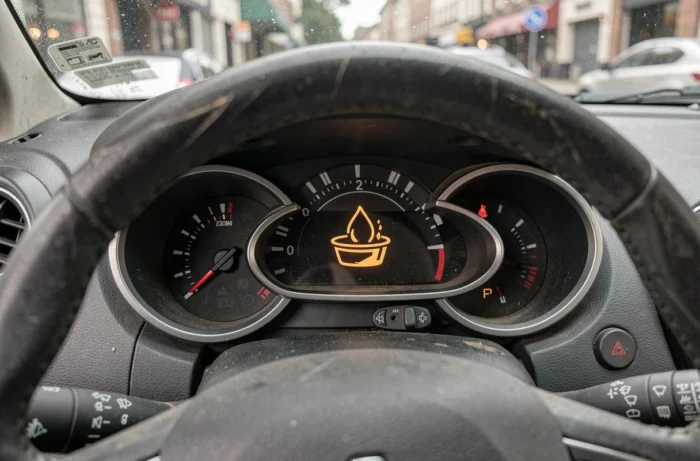
On a Clio 3, the warning light shaped like a droplet (or a basin with a wave) lights up one morning at startup, or worse, while driving. The usual reflex is to add oil and hope everything returns to normal. In most cases, this approach is sufficient. But when the light persists after adding oil, we shift to a different scenario, where diagnosis becomes the priority.
Orange light or red light on Clio 3: two alerts, two urgencies
The most common confusion concerns the color of the light. On the Clio 3, the droplet or basin symbol exists in two versions, and their severity is not the same.
The orange light signals a low oil level. The engine is still running with acceptable lubrication, but the reserve is decreasing. You can drive cautiously for a few dozen kilometers to reach a stopping point, check the gauge, and top up if necessary.
The red light indicates a drop in oil pressure in the circuit. The engine is no longer properly lubricated, and every kilometer traveled accelerates internal wear. In this case, the vehicle must be stopped immediately, engine off, without attempting to reach a garage on its own.
This color/sense distinction is often overlooked on older forums. However, recent maintenance guides emphasize a rising trend in engine failures related to the underestimation of oil alerts. If the droplet basin light on Clio 3 changes from orange to red after a top-up, the problem is no longer about the level.
Concrete diagnosis: low level, faulty sensor, or real pressure loss
Before making an appointment at the garage, you can eliminate several hypotheses yourself with minimal equipment.
Check the level on the gauge
With the engine off for at least five minutes (on flat ground), remove the dipstick, wipe it, reinsert it, and read the level. If it is below the minimum mark, a simple addition of oil suitable for the engine can turn off the light.
The point to watch next: record each oil top-up with the mileage. If you regularly add oil between two oil changes, this indicates abnormal consumption (seals, rings, turbo on dCi versions). This tracking helps detect a drift before a serious breakdown.
Test the reaction after topping up
After restoring the level, restart the engine. Three possible situations:
- The light goes off within a few seconds: the level was simply low, no pressure defect. Monitor consumption at the next fill-ups.
- The light stays on in orange: the level sensor may be clogged or faulty. On the Clio 3, this sensor is located in the oil sump and can give false alerts when it accumulates deposits.
- The light turns red or lights up red as soon as the engine starts: stop immediately. The problem concerns pressure, not level. Possible causes include a worn oil pump, a clogged oil filter, or an internal leak.
Listen to the engine
A metallic rattling at idle, especially when cold, combined with the red light, confirms a pressure defect. This noise indicates metal-to-metal contact in the crankshaft bearings or lifters. At this stage, diagnosis at the garage with a reading of the actual pressure via a gauge becomes the only reliable option.
Oil level sensor on Clio 3: the frequent false culprit
On high-mileage Clio 3s, the oil level sensor is a classic source of false alerts. This component, submerged in the sump, eventually becomes clogged with residues of degraded oil.
When the sensor is at fault, the light comes on while the manual gauge indicates a correct level. Feedback varies on this point: some owners resolve the issue with a simple oil change and cleaning of the sensor, while others need to replace the part.
A new sensor costs significantly less than an engine intervention. If the physical level is good and no suspicious noise accompanies the alert, having this sensor checked as a priority avoids heading towards heavier diagnostics.

Oil monitoring between oil changes: prevent the light from coming on
Recently published maintenance guides recommend not relying solely on the oil change interval to monitor the oil level. On a Clio 3, especially in diesel version, oil consumption can significantly increase with the age of the engine.
Three concrete habits reduce the risk of ending up with the light on:
- Check the dipstick every month or before each long trip, engine cold on flat ground.
- Note the amount added and the mileage in a notebook or dedicated app. Consumption higher than what is usual for the engine deserves thorough checking.
- Adhere to the oil viscosity recommended by Renault for the specific engine. An unsuitable oil alters the pressure in the circuit and can trigger the alert even with a correct level.
The droplet or basin light on the Clio 3 remains a signal to take seriously, but it does not necessarily mean heavy repairs. The color of the light guides the diagnosis, the gauge confirms or denies the level, and the behavior after topping up allows distinguishing a simple lack of oil from a mechanical or electronic defect. Keeping a written record of oil consumption remains the best way to spot a problem before it becomes costly.