A cat tree at a bargain price from an unknown online store, an “orthopedic” harness touted by a fake veterinarian on Facebook, a GPS collar sold off with delivery from an untraceable warehouse: cat owners are facing a proliferation of dubious feline accessory sites. Since the tightening of sanctions against pet shops in France, some unscrupulous sellers have turned to online accessory stores, where controls remain more vague.
Spotting these scams before pulling out your credit card requires some concrete reflexes.
Fake veterinarians and false health advice: the trap of sponsored content
We often come across these Facebook or Instagram posts where a supposed veterinarian, in a white coat, warns of a danger to your cat. The scenario is well-rehearsed: an animal on a drip, alarmist talk about a common product (litter, kibble, anti-parasitic), followed by a link to an accessory or dietary supplement store presented as the miracle solution.
The investigation conducted by TF1 in March 2026 revealed that several accounts of fake professionals generated by AI were using misleading marketing techniques on Meta platforms. These fake profiles sometimes take on the identity of real doctors, without their knowledge, to lend credibility to the approach. The sponsored content is enhanced by paid advertising, giving it artificial visibility.
Before clicking on a link to a feline accessory store recommended by a “professional” on social media, check that the account has existed for a long time, that it regularly publishes coherent content, and that it is linked to an identifiable practice or clinic. A real veterinarian does not sell collars via a sponsored Facebook link.
Concrete signs of scams on a cat accessory site
When consulting the reviews on aplouf com or other similar online stores, the same signals consistently appear in the feedback from trapped buyers. These indicators help filter fraudulent sites before placing any order.
- The physical address is absent or unverifiable. A legitimate site displays complete legal notices with a SIRET number (for French stores) or a European equivalent. If this information is missing, move on.
- Prices are abnormally low, sometimes three or four times lower than those of well-known brands. A cat tree or an automatic kibble dispenser at a ridiculous price serves as bait to collect banking information.
- Customer reviews are either non-existent or written in poor French with generic phrasing. You can check on Trustpilot or other independent review platforms if the site has a history of complaints.
- The payment method offered is limited to bank transfers or money transfer services, with no secure credit card option or PayPal.
Another frequent signal: the site was created very recently. You can check the creation date of a domain name using free Whois tools. A store that has appeared in the last few weeks offering hundreds of references for cat and dog accessories has no logistical credibility.
Targeted phishing after the I-Cad leak: when the scam arrives by email
Scams are not limited to fake stores. Following the cyberattack on the national identification file I-Cad, phishing campaigns have directly targeted cat, dog, and ferret owners. Scammers exploit stolen data (name, address, animal identification) to send personalized emails that mimic official communications.
The typical scenario: an email supposedly sent by I-Cad or an animal insurance organization asks you to “update” your pet’s information by clicking on a link. This link redirects to a fake site that collects your banking data. Some emails also offer accessories or health products for cats at discounted prices, using personal information to make the message credible.
To protect yourself, never click on a link received by email without checking the sender’s address. I-Cad does not ask for banking information via email. If in doubt, go directly to the official site without using the link in the message.
Decree of August 1, 2026, and its effects on online stores
The regulatory context partly explains the proliferation of these sites. Since a decree that came into effect on August 5, 2026, pet shops risk a 5th class fine (up to 1,500 euros per animal, 3,000 euros for repeat offenses) for any sale of dogs or cats. The exposure of animals visible from public roads is also subject to a 4th class fine.
In response to this tightening, some professionals circumvent the law by shifting to online accessory stores. The model is often the same: a Shopify storefront set up in a few hours, a catalog of feline accessories imported without quality control, and aggressive commercial practices (fake promotions, real-time stock counters, fake testimonials).
A cat accessory site linked to a previously sanctioned pet shop deserves particular vigilance. You can cross-check the name of the manager or the company with public databases (Infogreffe, service-public.fr) to check for any past issues.
Quick checks before buying a cat accessory online
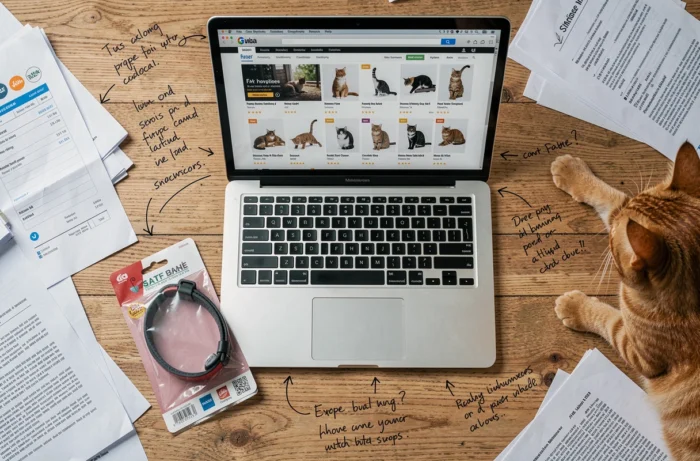
You don’t need to be a cybersecurity expert to filter out most fraudulent sites. A few checks take less than two minutes and can avoid most traps.
- Type the name of the site followed by “reviews” or “scam” into a search engine. Victim feedback usually appears on the first page.
- Check that the URL starts with “https” and that a padlock appears in the address bar. This is not an absolute guarantee, but its absence is a dealbreaker.
- Look for a phone number and call. Fraudulent sites never answer or redirect to a generic voicemail.
Feedback varies on this point, but several review platforms report that the most problematic sites frequently change their domain name while keeping the same catalog. If two different stores display exactly the same product photos and descriptions, it’s a network.
Protecting your cat also means protecting your own data. An accessory purchased from a dubious site can cost much more than its displayed price if your banking details end up in the wrong hands.