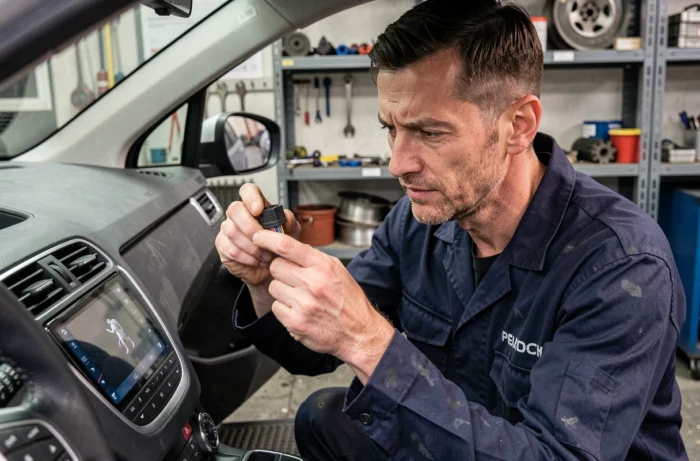
A Peugeot car radio does not connect like a universal car radio. The wiring harnesses of recent models (208 II, 308 III, 508 II) include data lines that are absent from generic diagrams. Confusing a data bus wire with a power wire can cause electronic faults across the entire dashboard.
Understanding the specific wiring diagram for Peugeot, wire by wire, remains a prerequisite for any reliable audio installation.
CAN Bus on Peugeot wiring harnesses: the trap that generic diagrams ignore
On recent Peugeots, the connector located behind the multimedia unit no longer consists solely of power and speaker wires. It includes connections dedicated to the CAN bus, an internal communication network within the vehicle. These lines carry information from the onboard computer, air conditioning, parking sensors, and sometimes vehicle configuration.
The concrete risk: connecting a speaker wire or a power wire to a CAN line. The result is not just silence. The vehicle parameter display may disappear, warning lights may illuminate, and the dealership will charge for an electronic diagnostic to trace the source of the problem.
A detailed Peugeot car radio wiring diagram allows for the visual identification of these CAN lines and distinguishes them from standard audio wires before any manipulation.
The basic rule: never connect anything to a wire whose function is not formally identified on the diagram for the exact model. A 308 II diagram does not correspond to that of a 308 III, even if both bear the same commercial name.
ISO Connector and Peugeot Wiring: Wire Color Matching
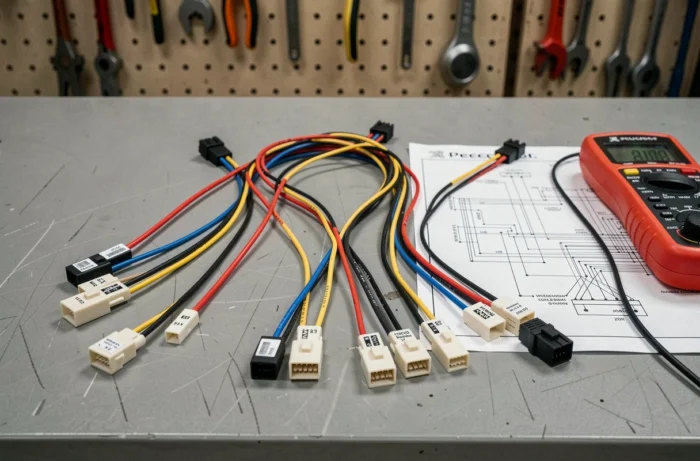
Most aftermarket car radios use the standardized ISO connector (ISO 10487 standard). This connector is divided into two blocks: a power block (connector A) and an audio block (connector B). The wire colors on these blocks follow a code commonly used in the automotive industry.
Power and Control Wires
- The yellow wire provides constant power (station memory, clock). It is directly connected to the battery and remains powered even when the ignition is off.
- The red wire corresponds to switched power, active only when the ignition is on. Connecting the red wire to a permanent circuit will drain the battery in a few days.
- The black wire is the ground. A poor ground point generates audible noise (humming, buzzing) that degrades the entire sound system.
Speaker Wires: Polarity and Identification
Each speaker is powered by a pair of wires: one positive and one negative. The standard colors are white and gray (front speakers), green and purple (rear speakers). The wire striped with a black band is always the negative of the pair.
Reversing the polarity of a single speaker cancels the bass across the entire installation. The sound waves emitted out of phase cancel each other out, resulting in a hollow and shallow sound, often mistakenly attributed to a fault in the car radio itself.
On some Peugeot models, the colors of the original harness do not exactly match the standard ISO code. A specific Peugeot ISO harness adapter (a few euros online) avoids cutting and stripping the original wires, preserving the warranty and facilitating a return to factory configuration.
DAB+ Compatibility and Steering Wheel Controls: Two Specific Peugeot Constraints
Since December 2020, a European directive requires that any car radio integrated into a new vehicle sold in the EU must be capable of receiving DAB+ digital terrestrial radio. Replacing a DAB+ compatible original car radio with an aftermarket model that is not compatible will lose access to this standard, while DAB+ coverage is gradually expanding across France.
Before choosing a replacement unit, checking for an integrated DAB+ tuner prevents the need to add an external module later, along with the additional wiring that entails.
Maintaining Steering Wheel Controls After Replacement
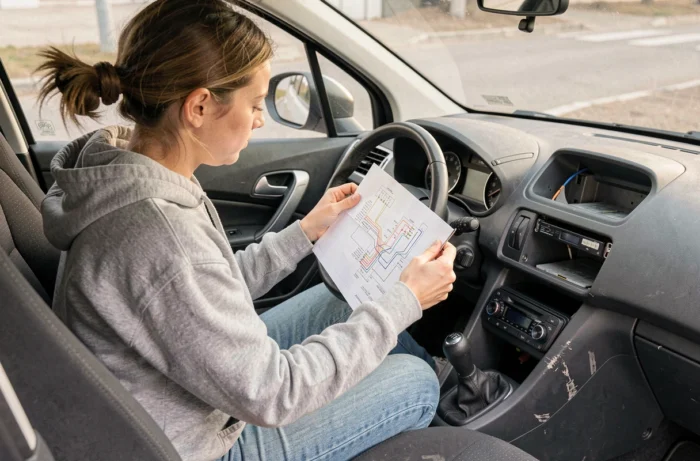
Peugeots equipped with steering wheel controls (volume, source change, next track) use either a resistive analog signal or a digital signal transmitted via the CAN bus, depending on the vehicle generation. An aftermarket car radio does not natively recognize this signal.
The solution involves a steering wheel control interface box, an intermediate module that translates the Peugeot signal into a protocol understood by the new car radio. Without this box, the steering wheel buttons become inactive. The wiring of this interface requires precisely identifying the steering wheel control wire on the original harness, often a wire of an uncommon color, absent from generic diagrams.
Sound Quality After Installation: Wiring Errors That Degrade Sound
An electrically functional connection does not guarantee correct sound output. Several wiring errors may go unnoticed on the first try but permanently affect listening quality.
A poorly tightened ground point or one fixed to painted metal creates parasitic resistance. The result: a constant hiss in the speakers, amplified proportionally to the volume. Sanding the metal down to bare metal before securing the ground terminal eliminates this problem at the source.
Wires that are too thin limit the power transmitted and generate unnecessary heating. Over a long distance between the car radio and the rear speakers, the cable gauge must be sufficient to avoid creating an audible signal loss.
Grouping audio wires and power wires in the same sheath promotes electromagnetic interference. Physically separating the power harness from the speaker harness, even by a few centimeters, significantly reduces the noise picked up while driving.
The last point to check after each installation is the phase test of the speakers, which can be done with a simple mono audio file played simultaneously on all speakers. If the sound seems weaker with all speakers active than with just one, at least one pair is wired out of phase.