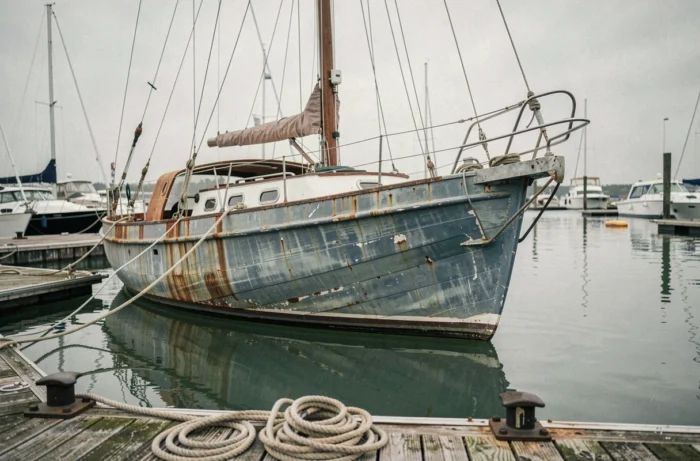
A 12-meter steel sailboat listed for six months on a classifieds platform, with an owner ready to move into a retirement home and a sound hull under the antifouling: this is the type of opportunity currently circulating in the second-hand market. The segment of used steel sailboats attracts those preparing for a long voyage or who want a boat capable of grounding without drama.
The market is moving, and good deals are not all found in the same place.
Negotiating on a used steel sailboat: the real margin
On classifieds platforms, the listed price of a used sailboat almost never corresponds to the final selling price. According to a market analysis published by Aiboatbuddy, used boats sell on average for 87% of the asking price. This represents a typical discount of about 13% off the listed price.
For a steel sailboat, this negotiation margin can even widen. Potential buyers are fewer than for a Jeanneau or a Bénéteau in fiberglass, which provides additional leverage. A boat that has been online for several months without serious offers indicates a seller who will eventually accept a significantly lower proposal.
It is also noted that many sellers of steel sailboats are former offshore sailors who are reselling after a trip around the Atlantic or an abandoned project. Their priority is to free up space in the harbor, not to increase the price. By targeting the sale of used steel sailboats on listings older than three months, you increase the chances of encountering this type of eager seller.
A steel sailboat listed for more than three months often negotiates well below the asking price. The timing of the offer is as important as the amount proposed.

Steel hull and actual condition: what costs money after purchase
Steel reassures with its strength, but it requires specific vigilance that fiberglass does not pose. The main problem is corrosion. A poorly maintained steel sailboat in terms of hull treatment may require complete sandblasting followed by epoxy reapplication, an operation whose cost often exceeds the negotiation obtained on the purchase price.
Checkpoints before buying a steel sailboat
- The residual thickness of the hull, measured by ultrasound: this is the only reliable indicator of structural condition. A maritime expert can perform this check in a few hours at the yard
- The condition of the sacrificial anodes and the grounding circuit: anodes consumed by more than half without recent replacement indicate neglected maintenance of the cathodic protection
- The quality of the interior hull treatment: condensation, rust stains under the lining, persistent damp smell. Interior rust costs more to treat than exterior rust
- The standing rigging: on a steel cruising sailboat, the shrouds and stays accumulate the miles. A complete replacement of the rigging represents a significant budget item
Feedback varies on the ideal frequency of hauling out a steel sailboat, but most experienced owners agree on a cycle of two to three years in temperate waters.
Steel cruising sailboat: models that retain their value
Not all used steel sailboats are equal in terms of depreciation. Some manufacturers have built a solid reputation based on construction quality and offshore design, which keeps prices stable in the resale market.
Steel sailboats from manufacturers specialized in long-distance cruising retain their value better than amateur steel hulls or one-off constructions without recognized plans. A sailboat built to plans from a recognized naval architect, with a complete construction file, reassures the next buyer and limits depreciation.
Amateur or professional construction: the price gap
The second-hand steel market has a notable proportion of amateur constructions. This is not a flaw in itself; some amateur builds surpass yard productions. However, the absence of technical documentation (construction plans, welding certificates, launch report) significantly lowers resale value.
For a buyer, this is a double-edged opportunity. One can acquire a solid sailboat at a very low price, but resale will be just as difficult. Requiring the complete technical file before signing remains the best protection against an unpleasant structural surprise.
Trends in the second-hand nautical market: why prices are rising
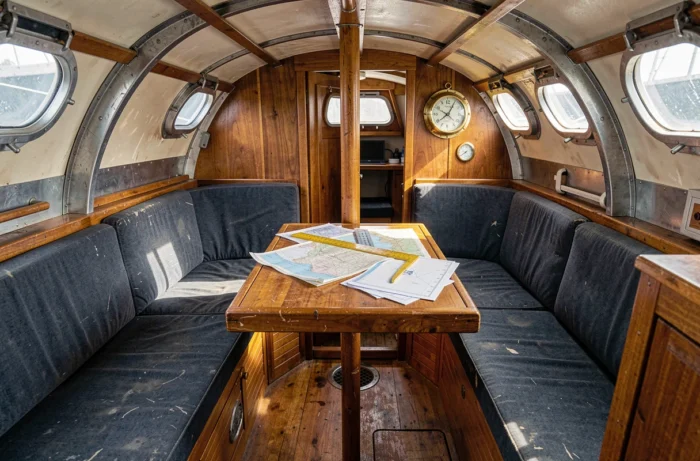
Recent data confirms that the average price of used boats has risen faster than that of new boats. The demand for units that are immediately available and proven at sea is driving prices up, including in the steel segment.
This phenomenon can be explained by several converging factors. Delivery times for new yards remain long, and a custom-built new steel sailboat often requires several years of construction. A buyer who wants to set sail within twelve months naturally turns to the second-hand market.
A ready-to-sail used steel sailboat is now proportionally worth more than it was a few years ago. Well-maintained units, with documented sailing history and recent equipment, sell quickly. Those that linger in listings are often unfinished projects or boats whose maintenance has been deferred.
To seize the best opportunities this year, it is advantageous to monitor end-of-season listings, when owners who have not sailed over the summer resign themselves to selling before paying for another year of docking. The months from September to December historically concentrate the best negotiation margins in the second-hand boating market.
One last often-overlooked point: the place of sale influences the price. A steel sailboat stored in a Breton port is not worth the same as the same boat in the Mediterranean, where berths are more expensive and demand is different. Cross-referencing listings from several geographical areas remains the most reliable way to spot an exploitable price gap.