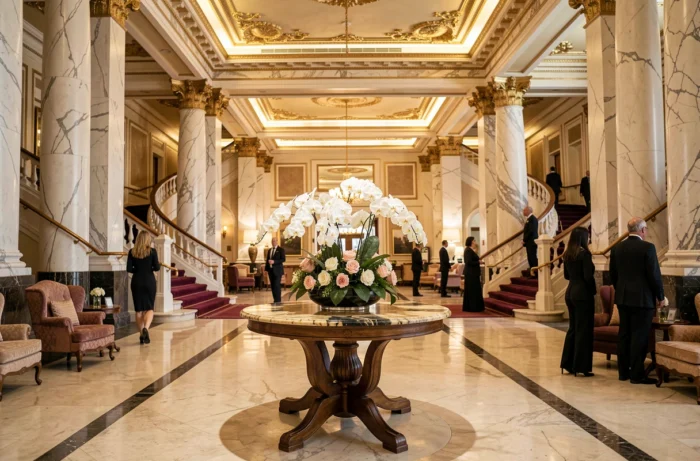
The “6 stars” label does not correspond to any official ranking recognized by a national or international authority. This mention, used by a handful of establishments around the world, is part of a marketing strategy without regulatory validity. Understanding this gap between hotel communication and normative reality allows for a better assessment of what these addresses actually offer, beyond the display.
Hotel Control and Star Rating: What is Tightening in 2026
Hotel rating systems vary significantly from country to country. In France, the official scale ranges from 1 to 5 stars, awarded by Atout France according to specific criteria. The “palace” designation distinguishes certain 5-star hotels, but no sixth star exists within the French legal framework.
Since July 1, 2026, South Korea has introduced a two-step procedure for awarding stars. The first control is announced: examination of the self-assessment file, verification of facilities and service standards. The second is unannounced: for 4 and 5-star hotels, an evaluator spends an anonymous night on-site posing as an ordinary customer.
This South Korean model illustrates an underlying trend. As authorities tighten their controls on classic high-end establishments, the claim of a self-proclaimed sixth star appears even more as a commercial argument disconnected from any verifiable assessment grid.
An overview allows for a comparison of 6-star hotels around the world based on their actual services rather than on a label without normative foundation.

6-Star Hotels: Comparative Table of Key Services
Rather than listing addresses, it is more useful to compare what these establishments actually offer. The table below gathers several hotels frequently presented as “6 stars” and contrasts their distinctive features.
| Establishment | Location | Architecture | Catering | Spa / Pool | Distinctive Service |
|---|---|---|---|---|---|
| Burj Al Arab Jumeirah | Dubai, United Arab Emirates | Sail shape, artificial island | 8 restaurants | Terrace with two pools | Dedicated butler, Rolls-Royce transfer |
| Emirates Palace (Mandarin Oriental) | Abu Dhabi, United Arab Emirates | Monumental palace, private beach | Multiple fine dining restaurants | Large spa, several pools | Royal suite, helipad |
| Soneva Jani | Maldives | Overwater villas with private slide | Open-air restaurants | Private pool per villa | Outdoor cinema, astronomical observatory |
| The Mark Hotel | New York, United States | Renovated Art Deco building | Jean-Georges Vongerichten restaurant | Private spa | One of the largest penthouses in the city |
| Hôtel Plaza Athénée | Paris, France | Haussmannian façade, Avenue Montaigne | Starred restaurant | Dior spa | Classified as “palace” (official French distinction) |
What emerges from this comparison is that no uniform criteria justify the 6-star label. A resort in the Maldives with a private pool and slide is not comparable to a Parisian palace on Avenue Montaigne. The common point is a very high pricing position and extremely personalized service.
Discrepancies Between Self-Proclaimed “6 Stars” and Palace Distinction in France
France created the “palace” distinction in 2010 to differentiate certain 5-star hotels without inventing a sixth category. This distinction is based on specific criteria: remarkable geographical location, historical or aesthetic character of the building, service offerings beyond the 5-star reference.
The Plaza Athénée and Le Bristol hold the title of palace, placing them in a verifiable and regulated category. In contrast, the Burj Al Arab in Dubai claims a “7-star” mention that has never been awarded by any Emirati authority. This mention comes exclusively from the establishment’s communication and certain media.
The gap is significant. On one side, a regulatory framework with inspection and periodic renewal. On the other, a self-declaration that is neither constrained nor verified. For the traveler, the practical difference lies less in the number of stars displayed than in three concrete dimensions:
- The staff-to-guest ratio, which determines service responsiveness (dedicated butler, concierge available at all times, staff exceeding the number of rooms)
- The exclusivity of spaces: private beach, individual pool, restricted access to common areas, which reduces crowd density
- Personalization before arrival: choice of pillow, room fragrance, minibar composition, activity program tailored to declared preferences
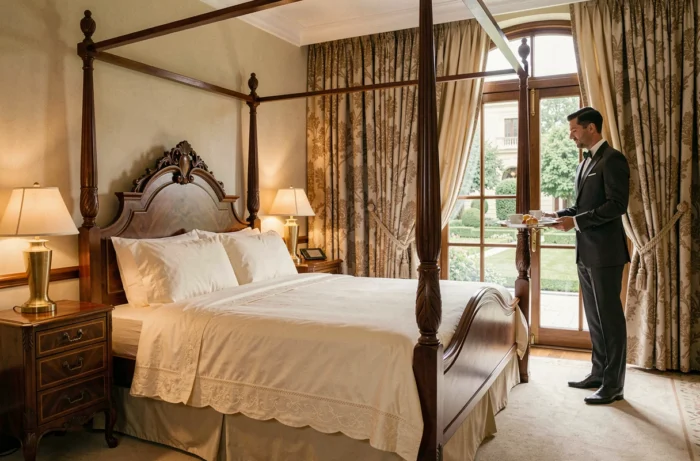
Forbes Travel Guide and the Race for Global Luxury Stars
The Forbes Travel Guide, an independent American organization, awards its own distinctions (5 Forbes stars being the maximum). In 2025, the guide published its annual Star Awards, rewarding establishments based on anonymous inspections focusing on service, facilities, and the quality of the customer experience.
This system, although private, offers a transparent and reproducible assessment grid. Inspectors spend several nights, test room service, the spa, dining, and rate each interaction. The methodology is public.
In contrast, hotels that claim 6 or 7 stars do not publish any reference framework. The traveler has no way of knowing which criteria have been met, as none exist. This opacity contrasts with the trend of tightening controls observed in South Korea or with the rigor of the Forbes Travel Guide.
What the Price of a Night in Ultra-Luxury Really Measures
The price of a night in these establishments varies significantly depending on the destination, season, and type of room. The range goes from a few thousand euros for a standard room to much higher amounts for presidential or royal suites.
This price rarely covers only accommodation. It often includes:
- A private transfer (helicopter, yacht, luxury vehicle with driver)
- Unlimited access to the spa and wellness facilities
- Custom concierge services (reservations, private excursions, exclusive experiences)
- Gourmet dining, sometimes all-inclusive in island resorts
The price reflects more the level of personalization than the number of stars displayed. A Parisian palace classified as 5 stars with palace distinction may offer a more structured and verifiable experience than a self-proclaimed 6-star resort in the Maldives, for a comparable price.
The ultra-luxury hotel market continues to grow globally, with an increase in projects in Europe and the Gulf. For the discerning traveler, the relevant question is not the number of claimed stars, but the transparency of the evaluation that underpins them.