
When the mention “debit transfer” appears on a statement from La Banque Postale, it indicates an outgoing flow validated by the account holder. However, this line can sow doubt, especially if the associated label is truncated or absent. Understanding the exact mechanism of the debit transfer at La Banque Postale requires distinguishing between what pertains to classical accounting, SEPA standards, and, recently, the verification of correspondence between IBAN and the beneficiary’s name.
Beneficiary verification: what changes for transfers at La Banque Postale
The European regulation 2024/886 requires payment service providers located in the euro zone to verify the correspondence between the IBAN and the beneficiary’s name. For institutions in the euro zone, this obligation has been in effect since October 2025. Some providers outside the euro zone have a later schedule, which can extend until 2027.
This verification, called Verification of Payee (VoP), does not only concern instant transfers. It also applies to classic SEPA transfers, a point that most online guides omit or confuse. Specifically, before a debit transfer is executed, the system compares the name entered by the sender with the one registered by the beneficiary’s bank.
To fully understand what debit transfer at Banque Postale means, one must incorporate this layer of control: the debit is no longer a simple execution order, but an order that goes through a step of nominative validation.
The verification service must be offered free of charge to the payer according to the European regulatory framework, meaning that no additional cost should appear on the debit line for this control operation.
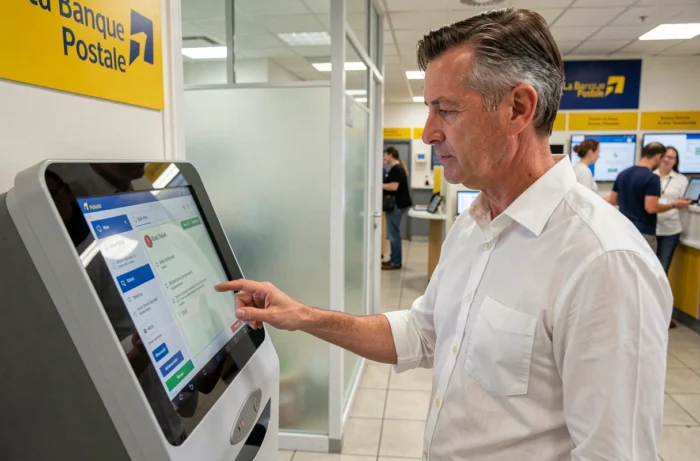
Debit transfer failed due to correspondence: the case of similar but inaccurate names
Feedback from experiences on the deployment of beneficiary verification reveals a concrete and frequent use case: the “close match.” A transfer goes into partial verification or gets blocked when the beneficiary’s name is abbreviated, misspelled, or does not exactly match the provided IBAN.
What the client sees in their online space
When entering a transfer in the client space of La Banque Postale, the system can return three types of responses after querying the recipient bank:
- Exact match: the entered name matches the IBAN, the transfer can be executed normally.
- Partial match: the name is close but not identical. The client receives a warning and can choose to proceed or cancel the order.
- No match: the name does not match at all. The transfer is blocked before execution, and the client is invited to verify the beneficiary’s details.
The determining point lies in the close match. An abbreviated first name (“J. Dupont” instead of “Jean Dupont”), a special character, or a missing accent can be enough to trigger the alert. The client then retains control: they can correct the name, confirm despite the warning, or abandon the operation.
Concrete actions before debit validation
As long as the transfer is not confirmed by the client after the partial match alert, no debit is made on the account. The account holder has several options:
- Modify the beneficiary’s name to match exactly the one registered with the recipient bank.
- Contact the beneficiary to obtain the exact spelling associated with their IBAN.
- Force validation despite the warning, which places the responsibility on the sender in case of routing errors.
This mechanism protects against input errors and attempts at fraud by substituting IBANs. However, it can slow down legitimate transfers when account labels contain administrative variations.
Classic or instant SEPA transfer at La Banque Postale: comparative table
| Criteria | Classic SEPA transfer | Instant transfer |
|---|---|---|
| Execution time | One business day on average | Several seconds |
| Beneficiary verification (VoP) | Mandatory since October 2025 | Mandatory since October 2025 |
| Cost of verification for the client | Free (European regulation) | Free (European regulation) |
| Management of close match | Alert before execution, client’s choice | Alert before execution, client’s choice |
| Cancellation after execution | Very difficult, depends on the receiving bank | Almost impossible once the funds are credited |
The table highlights a point often overlooked: the verification of the beneficiary applies equally to both types of transfer. The difference lies in the execution time and reversibility. A classic transfer allows for a window, even if narrow, to attempt a cancellation before actual execution. In contrast, an instant transfer is irrevocable once sent.

Label “debit transfer” without name: identifying the origin of the operation
Some clients of La Banque Postale notice a debit transfer without a visible beneficiary name on their statement. This case occurs when the label transmitted by the interbank system is truncated or when the transfer was initiated from a channel that does not systematically provide the recipient field in the history.
To trace the origin of an unidentified debit transfer, the most direct approach is to consult the operation’s details in the online client space. The internal reference number allows tracing back to the initial order. If the information remains insufficient, the customer service of La Banque Postale can provide the details of the beneficiary account that received the funds.
The mention “VIR” followed by “SEPA” in the label indicates a transfer compliant with European standards. The absence of this mention may signal an internal transfer between two accounts held at La Banque Postale, which follows a different circuit.
The introduction of beneficiary verification should reduce these cases of unidentified operations, as the beneficiary’s name is now checked before the debit execution. A transfer validated after a close match, however, retains the label entered by the sender, which may remain approximate on the statement.