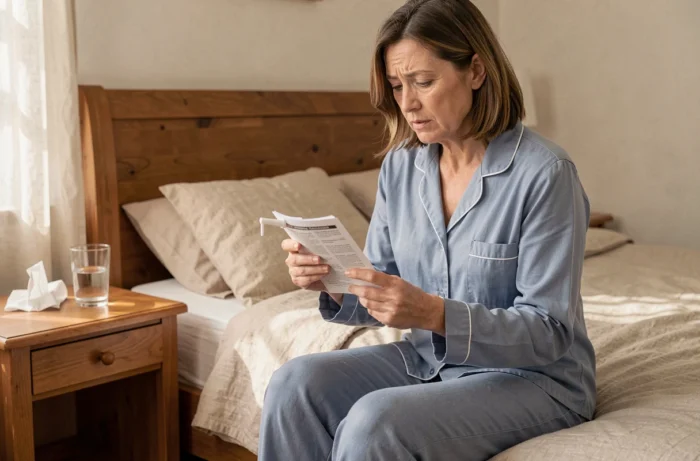
A Microlax has just been administered, we wait five minutes, ten, twenty, and nothing happens. This situation is common and often generates a understandable reflex: to take another dose. Before opening a second single-dose, it is essential to understand why the micro-enema did not work and to identify cases where the absence of results is a warning signal.
Microlax ineffective: what the failure of the micro-enema reveals about transit
Microlax contains sodium lauryl sulfoacetate, sorbitol, and dihydrated sodium citrate. These three components act exclusively in the rectum: they soften the stools present in the terminal part of the intestine and trigger a reflex to evacuate.
When the product remains ineffective, the problem often lies higher up in the colon. If the stools have not yet migrated to the rectum, the rectal solution simply has nothing to soften on-site. We end up treating an empty area while the blockage stagnates upstream.
Some medications significantly slow down transit (opioids, tricyclic antidepressants, iron supplements). In this case, a micro-enema alone is generally not enough. To know how long to wait after a Microlax before considering another approach, one can cross-reference the information in the leaflet with the pharmacist’s advice.
Another factor in failure relates to the administration itself. If the nozzle is not inserted correctly or if the product is expelled too quickly, the local action does not have time to occur. It is recommended to remain lying on one side for a few minutes after application.

Taking another Microlax: safety delay and adult dosage
The updated leaflet by the ANSM (dated May 20, 2025) does not set a universal delay between two administrations. However, it specifies to follow the dosage indicated on the presentation used and to consult a healthcare professional if constipation persists or if the treatment becomes repetitive.
In practice, most pharmacists advise against taking two single doses in the same hour. The absence of effect after the first dose does not mean that a second will be more effective, especially if the rectum is empty.
What to do before taking another dose
- Wait at least the time indicated on the leaflet of the presentation (varies according to the packaging) and check that you have indeed remained in the lying position after administration
- Drink a large glass of warm water and walk for a few minutes to stimulate natural peristalsis
- Gently massage the abdomen in a clockwise direction, from the ascending colon to the descending colon, for five to ten minutes
- If no evacuation occurs in the following hour, contact the pharmacist rather than multiplying enemas
Prolonged self-medication with micro-enemas is not recommended by the ANSM. When exceeding two to three days without improvement despite usual measures, a medical opinion allows ruling out a cause requiring different treatment.
Warning signs: when not to take a rectal laxative
Some situations turn a simple episode of constipation into a potential emergency. One should not attempt to unblock transit at home if a combination of these symptoms is observed:
- Intense or continuous abdominal pain, very swollen or hard belly to the touch
- Vomiting associated with the inability to pass gas
- Fever, general malaise, or blood in the stools
This combination may suggest a bowel obstruction, a situation where any laxative is contraindicated. The correct reflex is to call emergency services or go to the emergency room.
A recent and unusual constipation in a person who has never had transit problems also warrants a consultation, even without pain. Opinions vary on this point, but most French recommendations consider that a sudden change in transit persisting beyond two weeks justifies an assessment.
Alternatives to Microlax when constipation persists
If the micro-enema fails because the stools are located upstream of the rectum, we change strategy. Oral osmotic laxatives (macrogol, lactulose) act throughout the colon by drawing water into the intestinal lumen. Their effect takes longer to manifest, but they address the problem where it is located.
Bulk-forming laxatives (psyllium, ispaghul) increase stool volume and stimulate peristalsis. They require abundant hydration to function properly. Combining a bulk-forming laxative with insufficient fluid intake can worsen constipation.
Non-drug measures to combine with treatment
A diet rich in fiber (vegetables, fruits, whole grains) remains the foundation of management. Regular physical activity, even moderate, measurably boosts peristalsis.
The gastrocolic reflex, this natural movement of the colon triggered by food intake, is more pronounced in the morning. Going to the toilet within half an hour after breakfast exploits this mechanism and reduces the need for laxatives over time.
When constipation is related to medication, the doctor may adjust the dosage or prescribe a laxative suitable for the cause. Self-replacing a prescribed medication is never a safe option.
A Microlax that does not work does not necessarily call for a second Microlax. Identifying whether the problem is rectal or colonic, respecting the dosage in the leaflet, and monitoring warning signs remains the most reliable sequence before consulting.