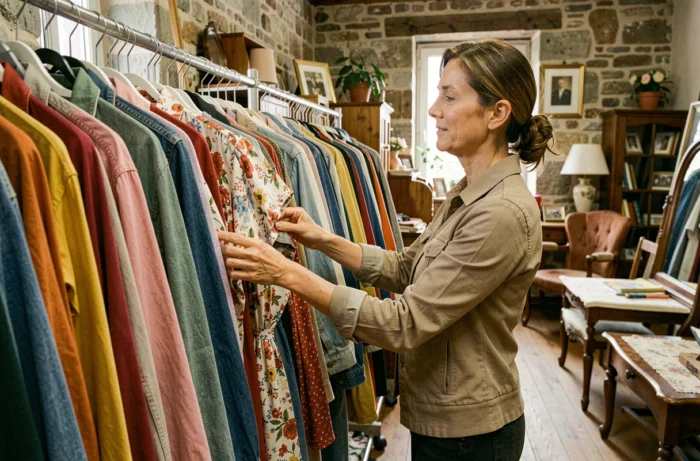
Bayonne has about ten shops specializing in second-hand clothing, mostly concentrated in two pedestrian areas. Finding a thrift store in Bayonne is not difficult, but spotting one that matches your style requires a bit of method. With sharp vintage selections, community thrift shops, and occasional events, the local offering covers a wide range of prices and eras.
What distinguishes a vintage thrift store from a simple consignment shop in Bayonne
You may have noticed that two second-hand shops located just a few streets apart can offer radically different experiences? The difference lies in the selection work done beforehand.
A vintage thrift store in the strict sense sorts its pieces by era, cut, or brand. The seller knows the origin of the lot, identifies the original labels, and sets a price based on rarity. A consignment shop, on the other hand, accepts what individuals drop off, without a marked stylistic filter.
In Bayonne, this distinction is reflected in the very layout of the shops. The addresses in the Saint-Esprit district, like Tatoum Vintage (5 rue Hugues), favor a curated selection of vintage pieces. Each rack corresponds to a decade or style. In contrast, some stores in the center operate more like generalist recycling centers where volume takes precedence over curation.
To delve deeper into this local ecosystem, a guide dedicated to thrift stores in Bayonne with Beauté Révolution details the specifics of each shop and their positioning.
Saint-Esprit district and Sainte-Catherine street: the area to know
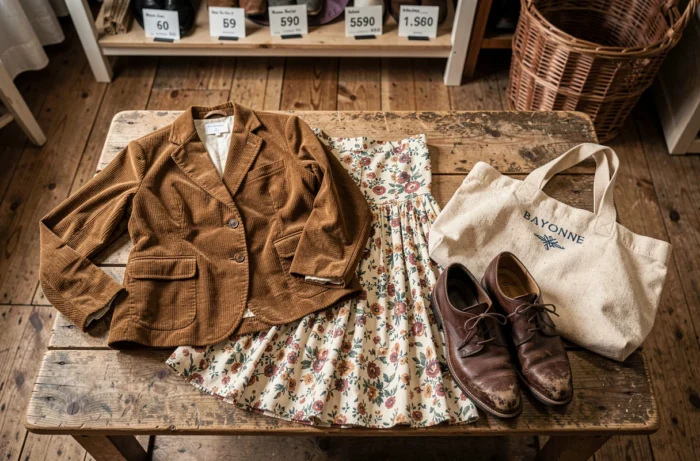
The majority of Bayonne’s thrift stores are concentrated on the right bank of the Adour, in the Saint-Esprit district. This area has undergone visible transformation in recent years: facade renovations, waterfront development, and the arrival of independent businesses. Vintage clothing shops have accompanied this movement.
Sainte-Catherine street and its extensions
Sainte-Catherine street is the heart of the thrift circuit in Saint-Esprit. Several shops can be found just a few meters apart, allowing for style comparisons in a single stroll. Le Comptoir d’Anna, for example, focuses on a bohemian chic atmosphere with pieces selected for their cut and material.
Azoka, located in the same area, positions itself on an equitable model with decreasing prices. This type of thrift store attracts an audience looking for both ethical engagement and rare pieces.
Petit Bayonne and complementary addresses
On the other side of the Nive, Petit Bayonne houses some complementary shops. Amaboomi (2 rue Jacques Laffitte) offers second-hand clothing in a more contemporary style. The neighborhood is also home to hybrid concept stores, like Le Jardin de Lili & Sam, which mix second-hand items and local creations.
The two neighborhoods can be explored on foot in less than an hour, making comparisons easier. A Saturday morning is enough to tour the main addresses.
Community thrift shops and sales: gems at very low prices
Second-hand shopping in Bayonne is not limited to storefront shops. Community organizations hold regular sales where prices drop well below those found in classic vintage thrift stores.
In Cambo-les-Bains, about twenty minutes from Bayonne, the association Orratzetik Hari organizes sales where a bag is provided at the entrance to facilitate bulk buying. This format suits those looking for everyday clothing at minimal prices rather than a collector’s item.
Flea markets and brocantes in the Basque Country complement the offering. The Puces de Quintaou, in Anglet, gather 150 exhibitors during certain editions and regularly offer lots of vintage clothing among stands of dishware and furniture.
Here are the alternative formats to know around Bayonne:
- Community sales (like Orratzetik Hari) with bag purchases, ideal for refreshing a complete wardrobe on a budget
- Clothing swaps organized in community halls or bars, where individuals sell their own clothes directly
- Flea markets in downtown Bayonne, which often include a few textile stands among decorative items
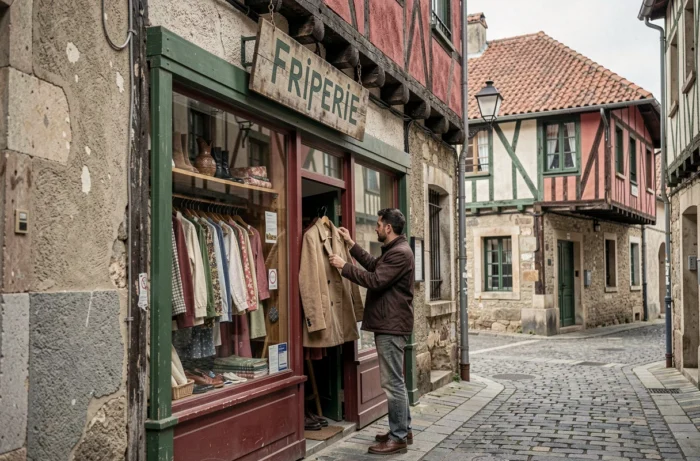
Concrete criteria for evaluating a thrift store before buying
Not all thrift stores are created equal, and price alone is not enough to judge the quality of a shop. A few guidelines can save you time.
- The condition of seams and zippers: a good thrift store checks these points before putting a piece up for sale. If you regularly find clothes with unreported defects, change shops
- Stock rotation: a shop that refreshes its racks every two to three weeks offers more finds than one where the same pieces linger for months
- The coherence of the selection: a mix of recent fast fashion and genuine vintage pieces from the 1970s in the same bin indicates a rough sorting
- Price transparency: some Bayonne thrift stores clearly display the decade of origin and the condition of the garment on the tag, making decision-making easier
The report from Oxfam France published in September 2026 reminds us that not all second-hand models have the same environmental impact. Buying from a local thrift store that selects its pieces remains more virtuous than ordering from an online resale platform with long-distance shipping.
The thrift stores in the Saint-Esprit district and Petit Bayonne offer a hunting ground varied enough to satisfy both rare vintage piece enthusiasts and pragmatic buyers. The best reflex is to visit regularly: arrivals are unpredictable, and the right piece is often found during an unplanned visit.