
A real estate developer displaying a flattering rating on their commercial window says nothing about their ability to deliver a program in accordance with the VEFA description. Customer reviews, when properly filtered and analyzed, constitute the only accessible feedback before signing. However, one must know what they are looking for, and especially what misleading information they might find.
Gap between commercial satisfaction and post-delivery quality of a real estate program
Most developers collect feedback at several stages of the purchasing journey: first contact, signing of the reservation contract, handover of keys. We observe a recurring bias in these systems. Internal surveys emphasize the commercial phase (welcome, clarity of contractual information, responsiveness of the advisor), while public reviews focus on delivery and reservations.
A published experience report on Eiffage Immobilier illustrates this discrepancy well: the internal survey showed favorable results regarding the welcome, but public reviews pointed out delivery delays and finishing defects. This type of divergence is not unique to a single player.
It reflects a structural weakness: the developer measures what they control (the sales process) and underestimates what the client endures (site monitoring, management of reservations, after-sales service).
For a buyer in VEFA, the useful reading of a review therefore begins after signing. Any comment that limits itself to “very professional sales team” without mentioning the construction phase or the compliance of the delivered housing has almost no predictive value regarding the actual reliability of the developer.
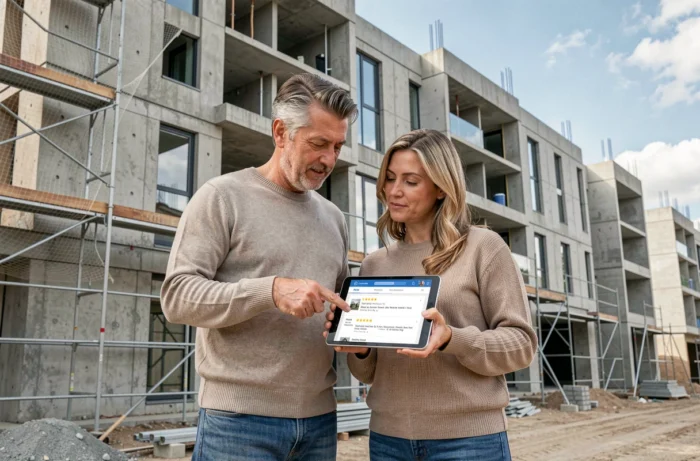
Verified reviews and legal framework: distinguishing reliable feedback from misleading signals
Since May 28, 2022, professionals who collect or disseminate reviews must specify the publication, moderation, and authenticity control methods. This transparency obligation allows for distinguishing a simple Google rating, where anyone can publish without proof of purchase, from a verified review system linked to a real transaction.
The penalty goes beyond administrative measures. Ordinance No. 2021-1734 of December 22, 2021, classified the dissemination of false reviews or their modification for promotional purposes as deceptive commercial practice. Law No. 2024-420 of May 10, 2024, further increased penalties when the offense is committed online, based on Articles L.121-4 and L.132-2 of the Consumer Code.
In practice, the DGCCRF actively monitors the authenticity of reviews, including in service sectors. We recommend systematically cross-referencing several sources before forming an opinion. Consulting reviews on the Franco Swiss developer on a dedicated platform, then comparing with Google ratings and specialized forums, significantly reduces the risk of relying on fabricated or selected testimonials.
Several signals should alert when reading reviews about a developer:
- Multiple five-star reviews published in the same week, with similar vocabulary and no mention of the relevant program, suggest a targeted solicitation campaign
- The total absence of negative reviews among a large volume of comments is statistically improbable and may indicate abusive filtering
- A detailed review mentioning the program name, delivery date, and specific reservations has significantly higher credibility than a generic comment
Review framework for assessing the reliability of a developer in VEFA
A useful customer review meets specific criteria. Not all feedback is equal, and the granularity of the testimony determines its value for a future buyer. Here are the points to check in each review before drawing a conclusion about a developer’s quality.
- Does the comment mention an identifiable program (name, city, year of delivery)? A review without geographical or temporal anchoring does not allow for judging the developer’s consistency
- Does the author distinguish between the commercial phase and the construction and post-delivery phase? Reliable developers generate reviews that cover the entire cycle, not just the sale
- Are the reservations at delivery described precisely (nature of the defect, timeline for resolution, responsiveness of after-sales service)? This level of detail is the best indicator of the guarantee of perfect completion as it is actually applied
- Does the developer publicly respond to negative reviews, and do their responses provide factual elements or are they limited to generic phrases?
This framework does not replace visiting already delivered programs or consulting the developer’s financial statements. It serves as a first filter to eliminate players whose reputation is based on façade marketing rather than the actual quality of delivered housing.
What reviews do not say about a new real estate project
Customer reviews never cover the financial solidity of the developer. A program delivered with acceptable finishes does not guarantee that the next one will benefit from the same construction budget. The financial health of a developer is verified through published accounts at the registry, not through Google stars.
Reviews also overlook regulatory compliance. A housing unit may satisfy its occupant while presenting non-compliance with acoustic or thermal standards that will only reveal themselves during use or upon resale. The ten-year guarantee covers structural disorders, but aesthetic defects often escape warranty provisions after the perfect completion period.
Finally, location and program choice remain decisions that reviews cannot illuminate. A well-rated developer on a project in Lyon may disappoint on a program in Bordeaux if they work with different local companies. Reputation is built program by program, not on a national brand scale.

Customer reviews are a pre-selection tool, not a certificate of reliability. Cross-referenced with the verification of the developer’s accounts, visits to previous deliveries, and examination of the VEFA contract, they reduce the risk of purchasing new real estate. Without this cross-referencing, they remain mere noise.